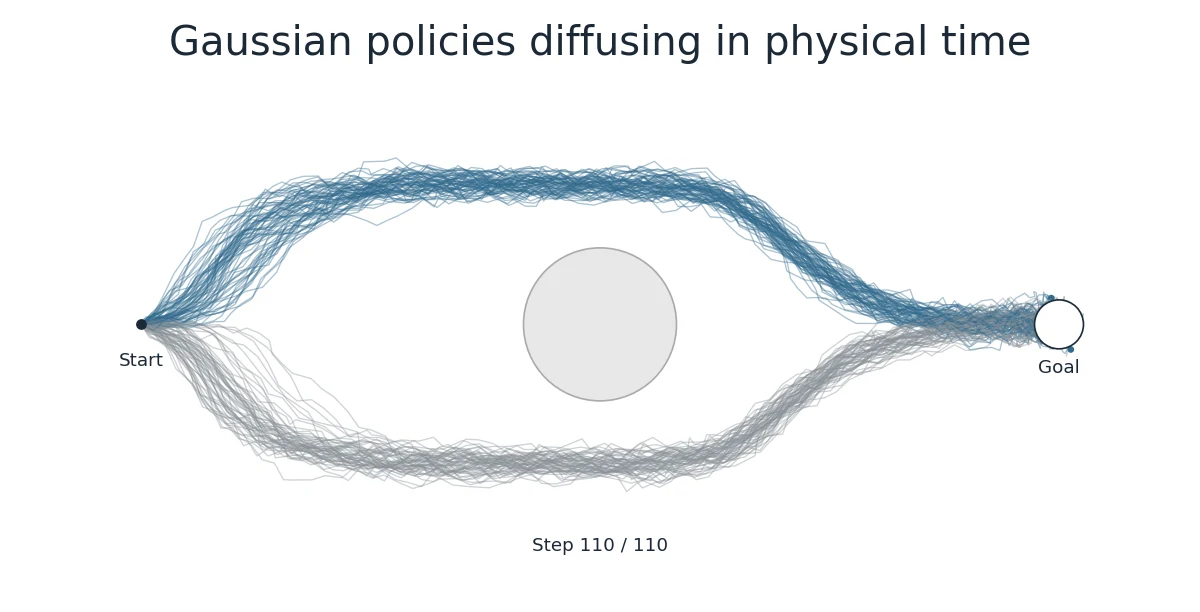
Gaussian actions can produce diverse behavior through diffusion in physical time. Change the noise to see how paths emerge.How this illustration works
This is a constructed 2D example, not a robot experiment. At each step, the action is drawn from one Gaussian whose mean depends on the current position. All 128 paths share the same rule and starting point; no route is assigned in advance. The slider scales the action’s standard deviation while keeping the mean field and random draws fixed. The circle marks a region to avoid; this illustration has no collision physics.
1 passthrough the action network
0.02%of eligible states for fitting
Up to 2×faster full policy calls
Closed formaction likelihoods
The observation
A complex sampler. A surprisingly simple distribution.
Flow policies generate actions through several network evaluations. But how complex are the distributions they produce?
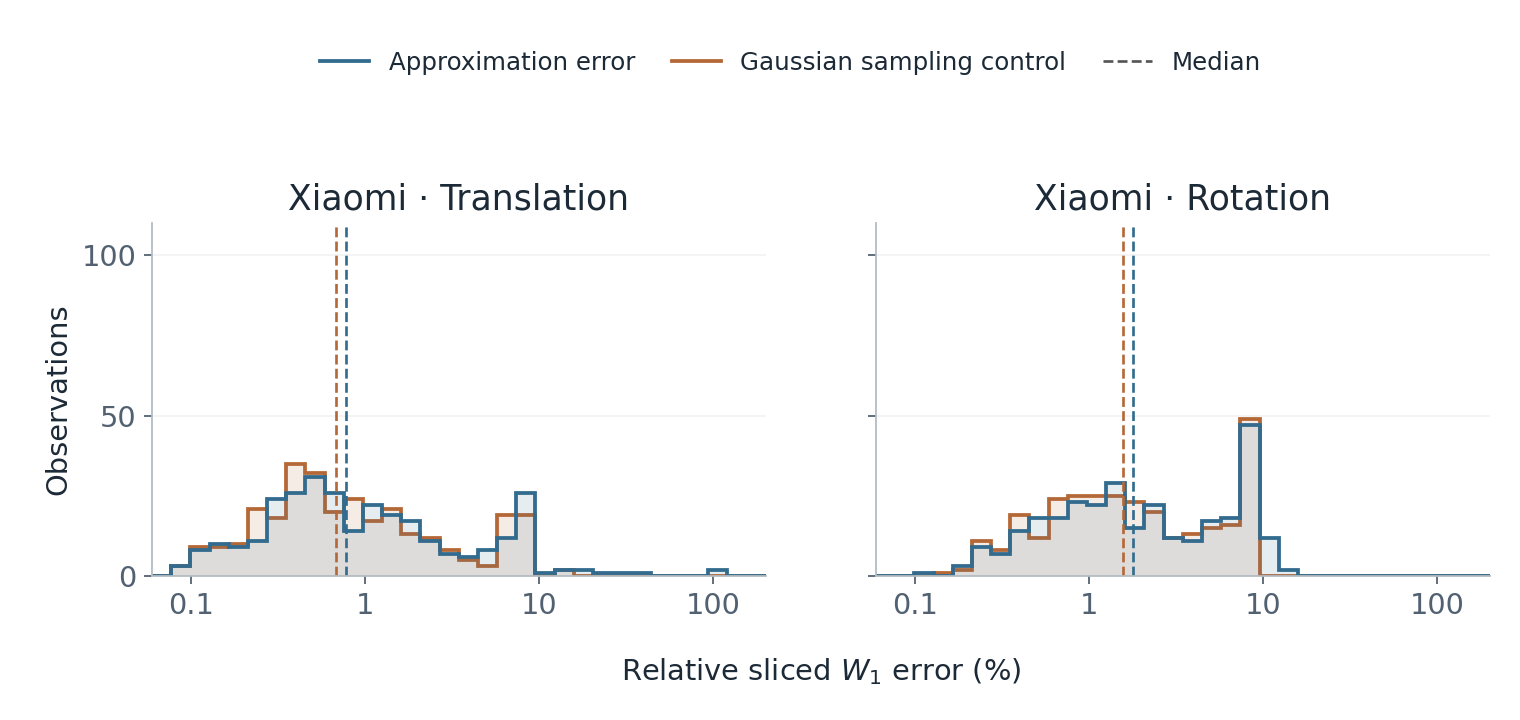
For the same robot observation, we sample many action chunks and compare their motion to a Gaussian. A Gaussian closely approximates both models’ motion distributions, especially Xiaomi’s.
For Xiaomi, relative errors are just 0.8% for translation and 1.8% for rotation across 16-action chunks.
Median relative sliced Wasserstein errors over 300 observations, using full covariance. The orange control measures the error expected when the samples themselves come from a Gaussian.
The fitted Gaussian captures Xiaomi’s motion distribution closely, including correlations across the action chunk.
The method
Keep the network. Replace the last layer.
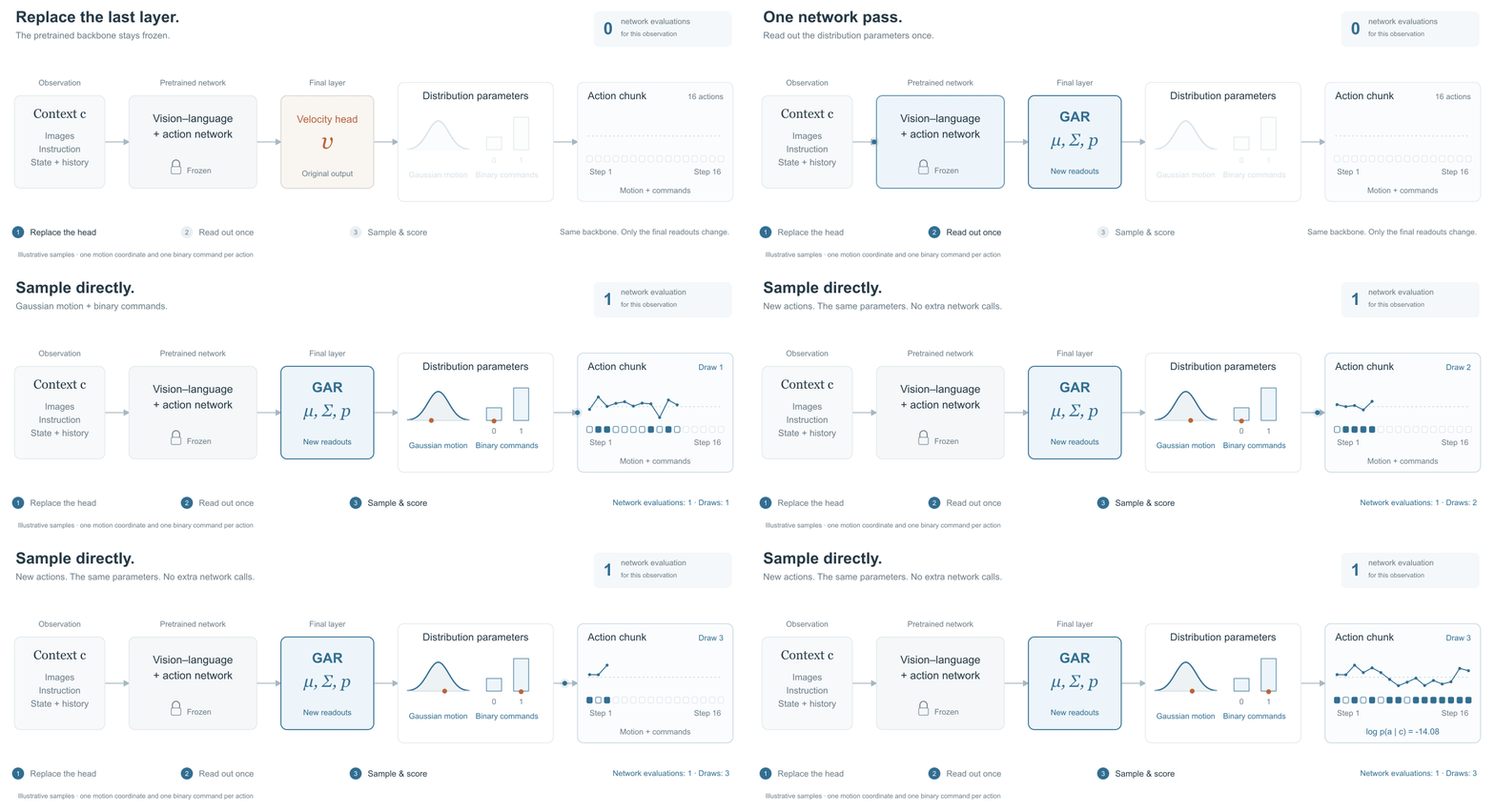
Our Gaussian Action Readout (GAR) turns a pretrained flow policy into a policy that samples directly. We freeze the network and train small readouts to predict the distribution’s parameters from its features.
One action-network evaluation gives the parameters for Gaussian motion and binary commands.
01
Collect the moments
Sample the teacher at 6,000 contexts to estimate means, covariances and command frequencies.
02
Fit the readouts
Use the teacher’s frozen features. Only the new readouts are trained, on 0.02% of eligible states.
03
Sample and score directly
Draw actions and compute their likelihoods without integrating a flow or making extra network calls.
With features and targets cached, fitting Xiaomi’s readouts takes about two minutes.
On the robot tasks
Similar task success. Fewer network evaluations.
We evaluate Xiaomi-Robotics-1 and GR00T N1.5 on 50 RoboCasa365 tasks, with 2,500 episodes per policy.
Task success with diagonal GAR
Model
Teacher
GAR
Speedup
Xiaomi
58.24%
57.64%
1.91×
GR00T
23.08%
21.92%
1.57×
GAR uses one action-network pass, replacing five flow steps for Xiaomi and four for GR00T.
Speedups measure the complete policy call, including the vision-language backbone, at batch size one.
Does Gaussian shape cost task success?
We also compare teacher motion samples with a Gaussian fitted to the teacher’s mean and full covariance, keeping binary-command handling fixed. Both models achieve similar success. These controls support the Gaussian approximation in practice, while separate mean-replacement tests show that mean-estimation errors can limit GR00T’s mean-only control.
Selected successful GAR rollouts. GR00T above, Xiaomi below; excerpts shown at 4× speed.
Explore the intuition
What’s hiding in the flow?
A Gaussian has a center and a spread. Move them below to see what the flow reveals about each.
μ
The center
Mean
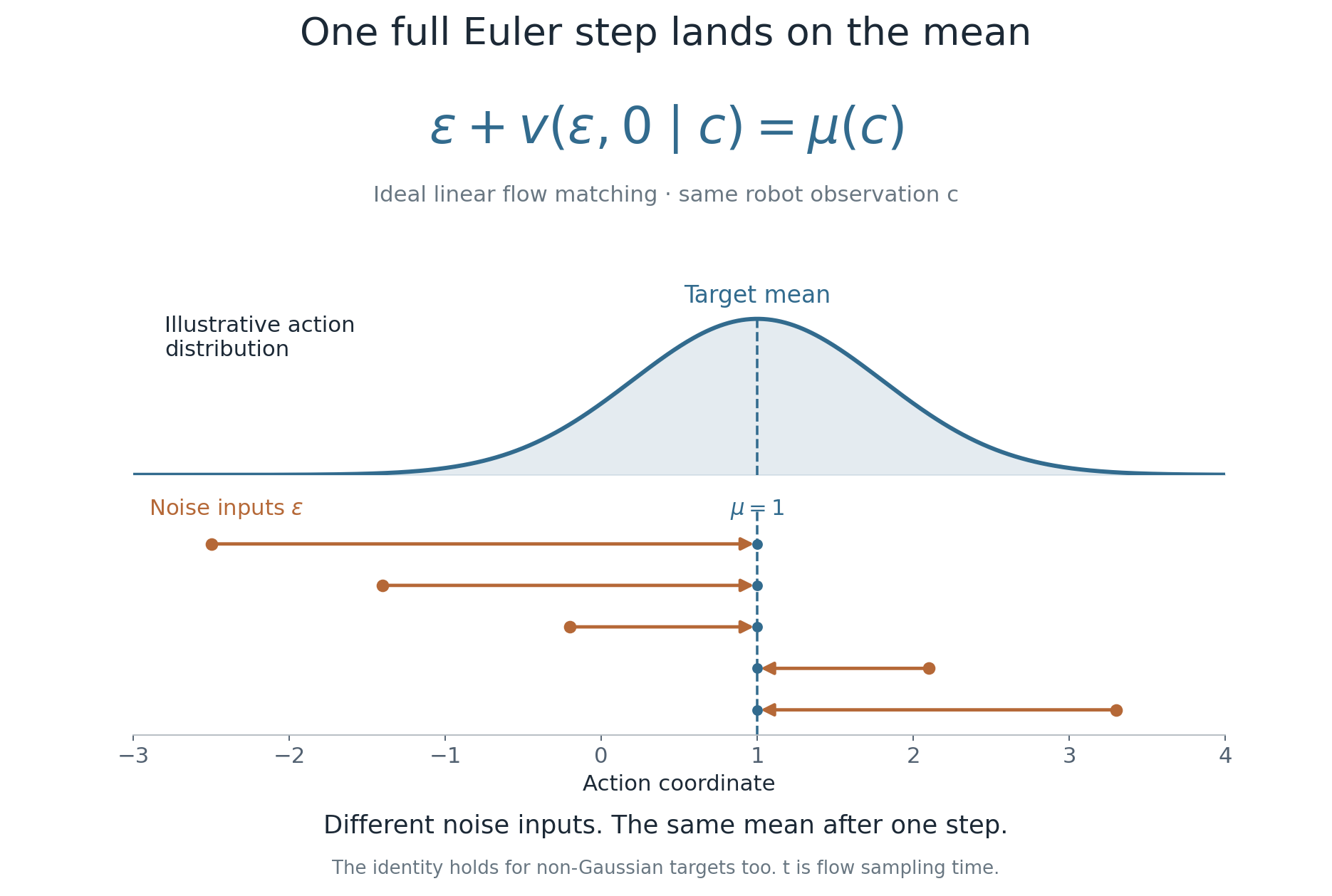
The mean is hiding in the initial velocity. Add the input noise back: every starting point lands on the same mean.
At t = 0ε + v(ε, 0) = μ
Different noise inputs. One answer.
The noise is known. One velocity evaluation gives the mean. For a Gaussian, that is also its most likely action.
σ²
The spread
Variance
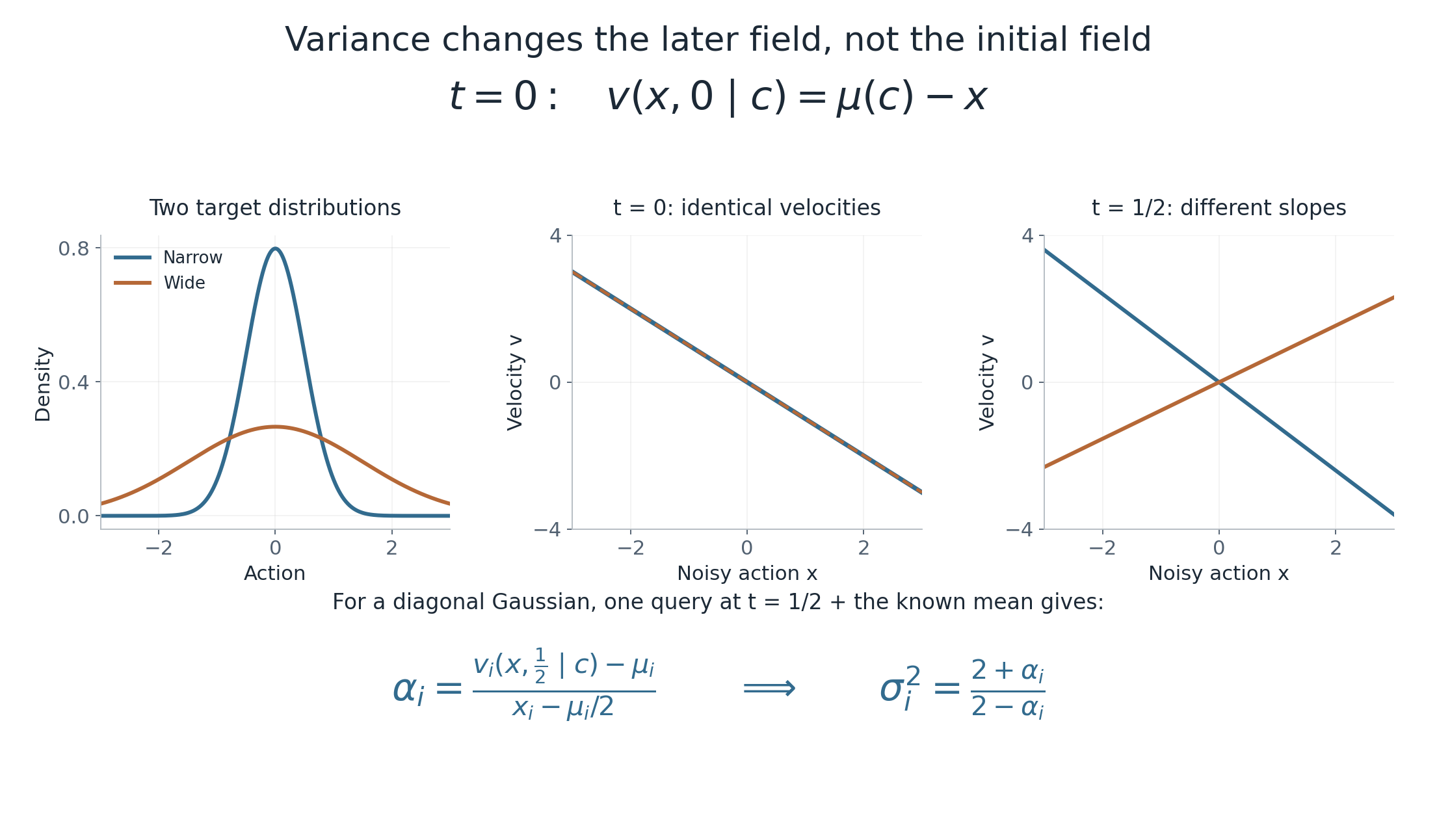
Different spreads give the same initial velocity. Move forward in flow time to see their velocity fields separate.
At t = ½σ² = 2 + α2 − αα = v(x, ½) − μx − μ / 2α is the velocity line’s slope; x ≠ μ/2.
Different spreads. Identical velocity at t = 0.
GAR learns to predict variance from frozen features, using teacher samples as training targets.
These illustrations use ideal linear flow matching from independent Gaussian noise. The mean identity also holds for non-Gaussian targets. GAR is fitted to the deployed teacher’s finite-step samples. Here, t is flow time, not physical time.
Beyond a single decision
One Gaussian does not mean one behavior.
Sampled actions change the state, which changes the next Gaussian. Through this feedback, a simple distribution at each decision can produce different behaviors over time: diffusion in physical time.
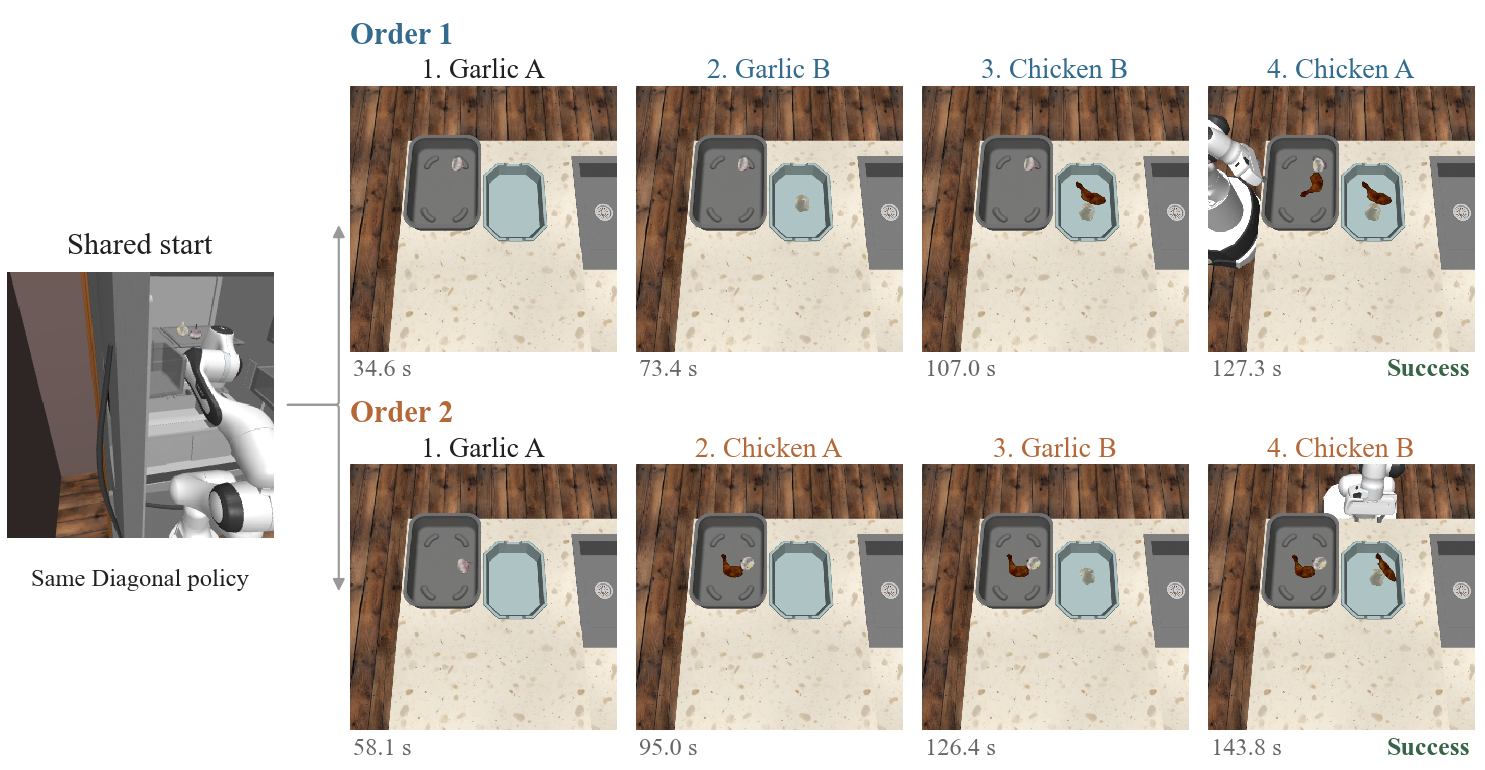
Same initial scene, different packing orders. Two selected successful Xiaomi GAR executions in RoboCasa.
The toy above shows the idea. The robot executions show that a Gaussian action policy can also support different task-solving behaviors.
The paper
Gaussian Distillation of Flow Policies
Youssef Saied, Ziyad Sheebaelhamd, Claire Vernade and François Fleuret